

This post was originally published by Indianapolis Business Journal. Click here to read the original article.
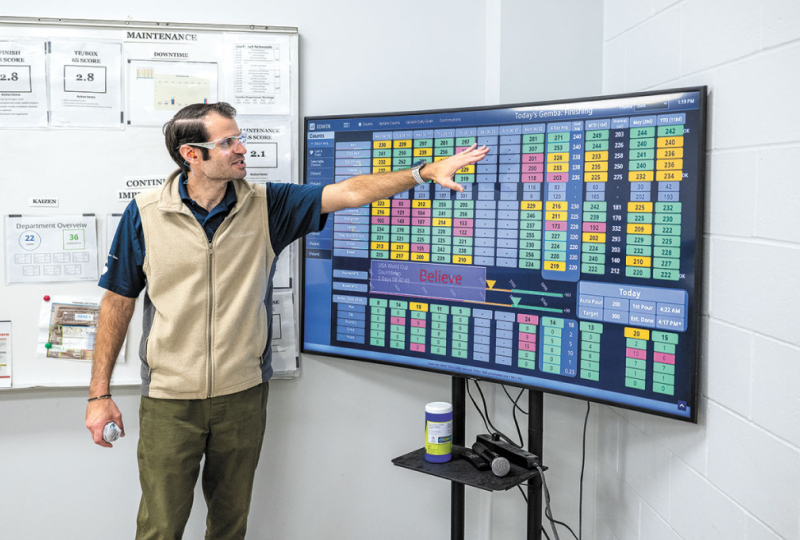
Batuhan Ak, general manager of Yamaha Marine Precision Propellers Inc., says AI helped the company make sense of mountains of data so it could fix manufacturing problems that were leading to defective boat propellers. (IBJ photo/Chad Williams)
It’s not much of a stretch to say that artificial intelligence helped Greenfield-based Yamaha Marine Precision Propellers Inc. escape financial disaster.
A few years ago, when Yamaha found itself mired in a costly and complicated manufacturing problem it couldn’t solve — an unexpected spike in the defect rate of the boat propellers it produces — the company turned to AI to help uncover the solution.
“We had a mission-critical need for the technology,” said Batuhan Ak, Yamaha Marine’s general manager.
If not for AI, Ak said, he’s not sure how long it might have taken to solve the problem — or what the financial consequences could have been.
“Could Yamaha have stomached years and decades worth of the [poor] financial performance associated with that high scrap rate? I don’t think most companies would have stomached that, honestly,” Ak said.
Now, a new statewide initiative, IN AI, aims to help other Indiana companies find their own ways to succeed with the technology.
The IN AI initiative officially launched in April, funded with a $1.64 million investment from the Indiana Economic Development Corp. Indianapolis-based CEOs of Indiana Corporate Partnership, or CICP, is overseeing the two-year initiative.
The overall goals: Improve business productivity, raise employee wages and provide work experiences that prepare college students for the AI age.
CICP CEO Melina Kennedy described IN AI as a “time-bound, two-year kind of sprint,” at the end of which CICP will re-evaluate whether to continue the initiative.
“The idea was to move fast in this time and reach as many [businesses] as possible in a way that’s understandable and accessible for small and medium-sized businesses,” Kennedy said.
Although AI has been widely available for several years, many companies still have not taken the leap of incorporating the technology into their operations.
According to data from the U.S. Census Bureau, 71.6% of Indiana businesses surveyed from Nov. 17 to Feb. 8 said they had not used AI for any of their business functions in the past two weeks. That percentage was nearly identical to the national figure of 71.3%. (The Census Bureau surveyed 1.2 million U.S. businesses. The Indiana data is a subset of the national data, but the Census Bureau did not specify how many Indiana businesses took part in the survey.)
According to that same survey, 56.2% of all U.S. businesses and 59.9% of Indiana businesses said they do not expect to use AI — including machine learning, natural language processing, virtual agents or voice recognition software — in any of their business functions in the next six months.
Program components
Per CICP’s contract with the IEDC, IN AI encompasses several components. CICP must provide:
- Three to five in-person gatherings in different parts of the state, plus two virtual gatherings, in each of the two years of the contract. The events are to be geared toward small-business leaders but open to the public. The gatherings, which IN AI calls road shows, will showcase companies that have implemented AI successfully, and they will introduce attendees to AI tools.
- An online resource guide that includes components such as AI-use case studies from Indiana companies; an adoption playbook to help companies implement AI; a directory of consultants and others who can help with AI projects; and lists of AI training resources available across the state.
- An online marketplace designed to match companies with university talent that can help with AI projects.
CICP and its industry-focused initiatives, which include manufacturing-and-logistics-focused Conexus Indiana and agbioscience-focused AgriNovus Indiana, have long championed the adoption of advanced technologies as a way for Indiana companies to improve their operations and remain competitive.
But AI is different from those other advanced technologies in an important way, said Jahon Hobbeheydar, vice president of strategy at CICP.
“The barriers to investment — both in terms of the factory level, the business level and the employee level — are quite low,” Hobbeheydar said. “They’re lower than robotics; they’re lower than automation, things like that. And so this is a productivity-enhancing, advanced technology that is more available to everyone than what we’ve seen in the past.”
In some cases, IN AI is merely highlighting AI resources that previously existed. A separate initiative called AnalytiXIN, for example, launched in 2021. AnalytiXIN focuses on connecting university talent with industry to accelerate Indiana’s AI and data analytics capabilities. And some of the online content existed before IN AI launched.
But IN AI intends to expand the talent-matching beyond what AnalytiXIN has done, Hobbeheydar said. And other aspects of the initiative, including the online and in-person gatherings, are new.
“The really nice thing about the partnership with the state, with the Governor’s Office, is, we can do more and we can do it faster,” Hobbeheydar said.
‘What is going on?’
Yamaha Marine is one of the AI success stories that IN AI will amplify over the next two years, showcasing ways AI can be used across different industries.
For Yamaha Marine, AI was the solution to a knotty problem the company had been unable to untangle.
From 2021 to 2024, the company shifted its operations from Indianapolis to Greenfield, building a brand-new automated facility to replace the 1970s-era production methods the company had been using.
But the shift to the new production methods caused an unexpected and costly spike in Yamaha’s scrap rate — the percentage of parts that were unusable due to defects. At the Indianapolis plant, the scrap rate hovered between 2% and 5%. At the new site, the scrap rate rose above 15%, and costs rose as a result. No one knew how to fix the problem.
Yamaha Marine had access to voluminous data from its new automated plant, but Ak described it as “information overload” and said the company didn’t know how to interpret the data.
“When we built this [Greenfield] facility, with all of the automation that we had, all the digitization that we had, our scrap rate more than tripled,” Ak said. “We could not figure out — ‘What is going on?’”
The company looked at hiring an outside data scientist to help it solve the problem, but Ak said the cost would have been hundreds of thousands of dollars, with no guarantee the approach would lead to a solution.
The search for answers led Yamaha Marine to Purdue University’s Data Mine program, which connects Purdue students with Indiana companies that need help with data science problems. After two years of work, the students produced a machine-learning model that allowed Yamaha Marine to diagnose its problem and figure out how to solve it. The company was able to reduce its scrap rate to below 1%, saving more than $1 million annually in the process.
“We’re a sub-$50 million [annual revenue] company, so that’s huge for us from a bottom-line standpoint,” Ak said. “It’s the difference between being profitable and not being profitable. It is that big of an impact.”
‘Never worked out properly’
Indianapolis-based Arcamed LLC, which makes medical cases and trays, offers another type of AI success story that IN AI plans to share.
Unlike Yamaha Marine, Arcamed began using AI in smaller ways before working up to more challenging problems. The company has 75 employees, all but two of whom are local.
The company began exploring AI about two years ago as a tool for automating time-consuming and routine tasks. Its first project was to create an AI chatbot that employees could use to answer basic human resources questions.
“We found that our HR generalists spent a lot of time either answering emails or [talking with] people popping into their office to ask general handbook questions,” said Arcamed President and CEO Jon Desalvo.
The chatbot is trained on Arcamed’s employee handbook and can answer questions such as how many days off an employee has earned or specifics on the company’s bereavement policy. Office employees can access the chatbot from their computers, and production employees can access it via a computer terminal installed on the shop floor.
The chatbot, Desalvo said, has saved Arcamed’s human resources staff about 10 hours a month. It was also a test case that was useful to all employees, giving the entire staff a chance to get familiar with AI and its capabilities in a nonthreatening way.
Arcamed has also found other ways to use AI, including as a manufacturing planning tool.
Because the company is a contract manufacturer, producing a different mix of items for different customers, it must routinely change its production setup.
Making these changes involves consideration of several factors, including the complexity of the part and the time needed to inspect it as well as which employees to assign to the task based on their particular expertise.
“We used to have to try to do all of that manually,” Desalvo said. “And it just became so time-consuming, and it never worked out properly.”
AI does a better job with the planning, he said, and it identifies opportunities for using each production setup most efficiently.
“We can optimize one setup to maybe run 10 or 12 different parts instead of changing that setup 10 to 12 different times,” Desalvo said. “We didn’t have the sophistication before AI to tell us what all could be run without trying to manually sort through all of that information.”
Although IN AI is only a few months old, CICP officials said they are encouraged by early response to the initiative.
Its first official gathering, a virtual road show held earlier this month, drew about 100 participants. The first in-person road show event is set for July 21 in Indianapolis, followed by events in West Lafayette, South Bend, Evansville and Bloomington from August to October. A second virtual event is planned for November.
In addition, a free half-day workshop on how to use Anthropic’s Claude AI tool drew interest from about 400 people — nearly four times the capacity of the event, where attendance was capped at 120.
Ting Gootee, CICP’s executive vice president of digital adoption and managing director of Crossroads Health Ventures, said “people’s genuine interest in wanting to learn and apply [AI tools] and make themselves more productive has been exceeding my expectations.”