

This post was originally published by Indianapolis Business Journal. Click here to read the original article.
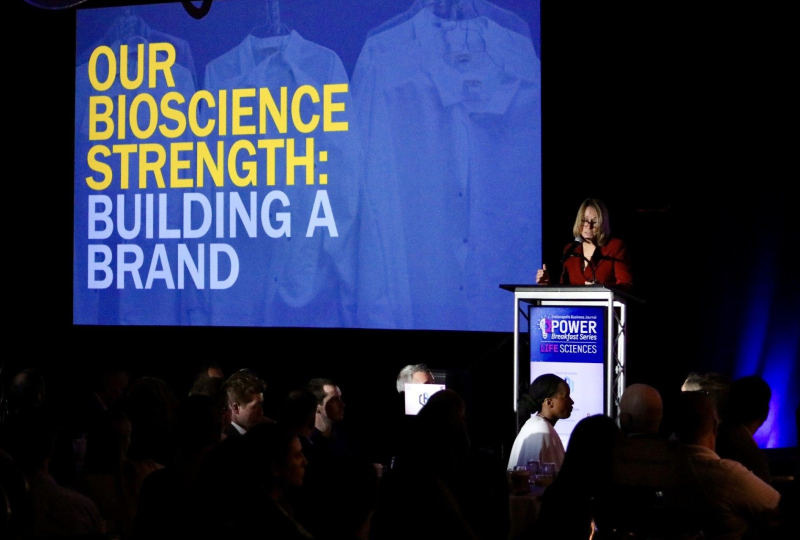 Central Indiana is a world leader in life sciences innovation, but the region needs to develop a distinct brand and message to continue its momentum, speakers said Thursday at IBJ’s Life Sciences Power Breakfast.
Keynote speaker Chad Shearer, director of research for New York-based The Global Institute on Innovation Districts, told an audience of about 350 attendees in the life sciences sector that central Indiana stands apart as a region in nearly every category of invention and innovation.
The CEOs of Indiana Corporate Partnership hired The Global Institute on Innovation Districts to help it develop a unified brand and message around life sciences, identify the region, encourage investment, attract talent and set the region apart globally as a hub for research, development and manufacturing.
“This is a really, really interesting region, not just for its biosciences strengths but also because it contains a critical mass of bioscience companies that don’t usually compete directly with one another, which means they all are using the same science,” Shearer said. “They all need the same kind of production techniques, and that creates huge incentives, probably, we hope, to work together. We see enormous potential for more spillovers to happen between the companies that are innovating from this region.”
CICP CEO Melina Kennedy said that means it’s time for central Indiana to develop a distinct identity in the same way that regions like the North Carolina Research Triangle, Silicon Valley in California and Kendall Square in Massachusetts already have.
She also said the direct economic impact of the life sciences industry in Indiana is $125 billion.
“We can definitely punch above our weight class and go to toe to toe with our competitors,” Kennedy said. “But we’ve got to translate all these strengths into a unified brand identity and story that can attract more investment and more talent.”
Shearer cited statistics that show life sciences represent large shares of discoveries, inventions and enterprise. Nearly 13,000 inventions have been patented in central Indiana since 2010, he said, which is about 2.9 times the national average. Of that total number of inventions, 35% of local inventions relate to life sciences, about 1.6 times the national average.
Additionally, Shearer said, advanced industries represent $34.8 billion of gross product in central Indiana, or about 19% of the total gross product, which is 1.5 times the national average.
He added that life sciences hot spots in central Indiana represent 0.1% of land in the 11-county region. However, they drive a majority of the region’s innovation through discovery, advanced manufacturing, employment, startup and growth capital flows, advanced services, employment and inventions.
“They’ve made central Indiana an absolute innovation powerhouse,” Shearer said. “That’s a kind of key finding from the work that we’ve been doing with CICP in the region.”
Shearer and Kennedy both cited the connection of industry, higher education and manufacturing. Central Indiana has leaders in human, animal and plant health in Eli Lilly and Co., Elanco Animal Health and Corteva Agrisciences, along with the largest medical school in the country in the Indiana University School of Medicine, and separate Indiana and Purdue University campuses.
Shearer also noted the growth of innovation districts that include the LEAP Research and Innovation District in Lebanon, OneHealth Innovation District and 16 Tech Innovation District in Indianapolis and Innovation Mile in Noblesville. Also, Fishers has put a focus on life sciences at its Fishers Life Science Innovation Corridor, which includes companies like INCOG BioPharma and Italy-based Stevanato Group.
Central Indiana “is one of the first regions in the world that is thinking ahead about how to make sure that all of this investment in these place-based innovation geographies adds up to something more,” Shearer said.
Kennedy said work is continuing to develop a name for the central Indiana region and to better communicate what the life sciences ecosystem represents.
“We’ve got to tell a good story, and frankly our competitors, who we’re up against every single day, are doing that, and they’re doing that well,” she said. “We need to have a sense of urgency, because our competitors are telling their story. They’re out there with their narratives.”