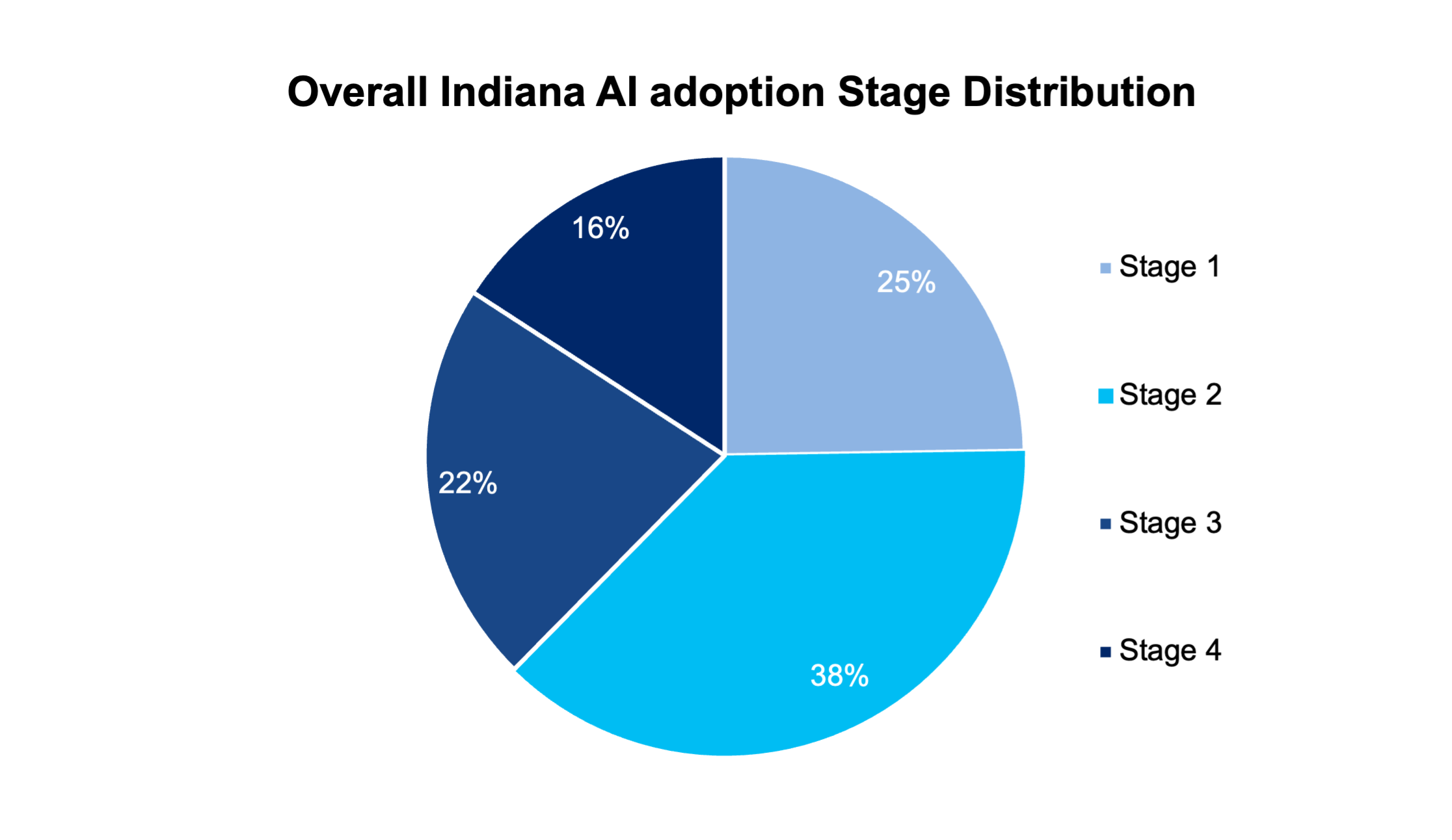
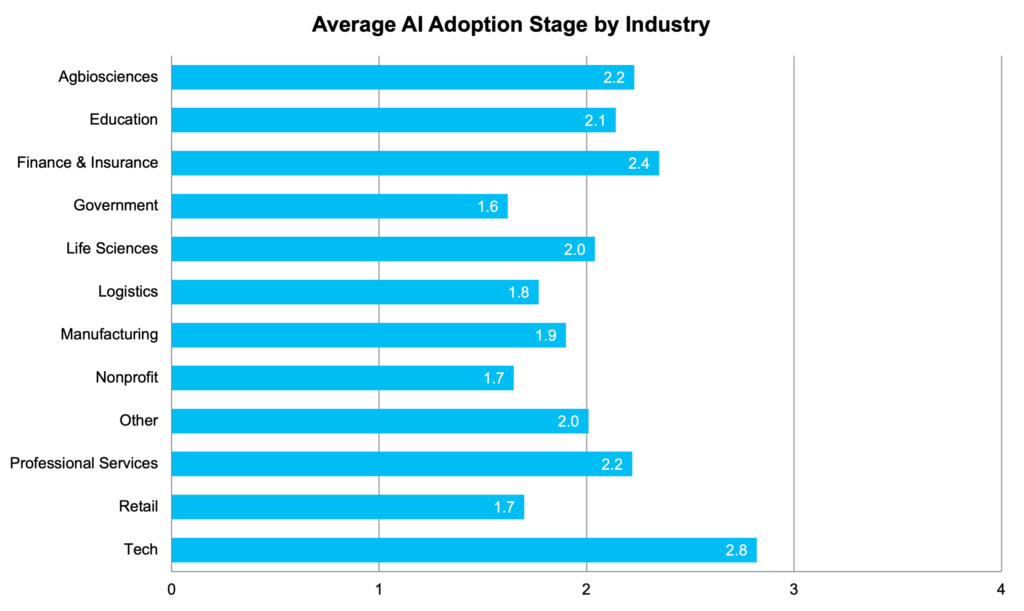
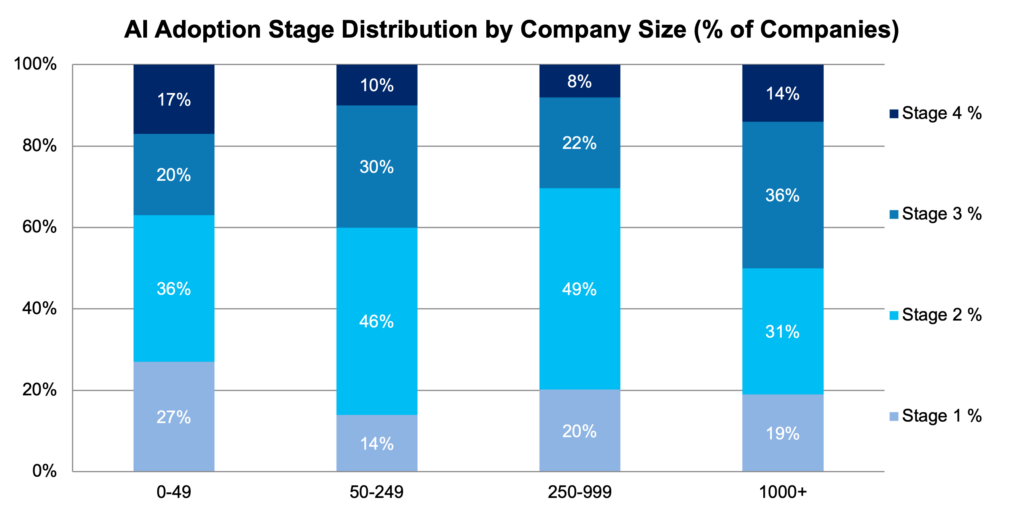
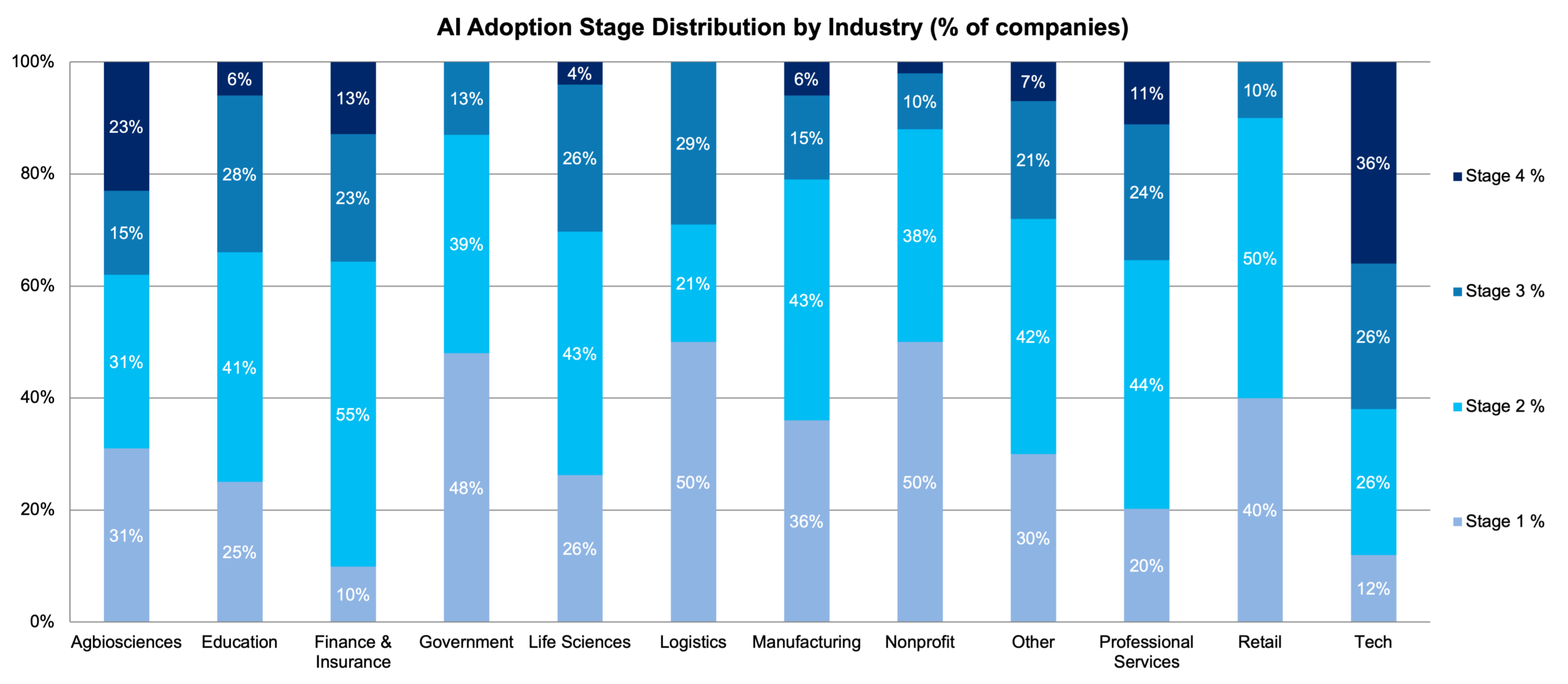
These figures are drawn from more than 900 data points collected across nearly 700 Indiana companies over the first three months since IN AI’s initial launch in late April 2026: the IN AI Roadshows, partner events, and AI Readiness Assessment submissions. Where a company responded more than once, its results were averaged into a single company-level score rather than counted twice, so no single organization skews the numbers.
Each company self-reported where it stands on a four-stage AI adoption scale, from early exploration (Stage 1) to full integration into core operations (Stage 4). Industries and company sizes were consolidated into consistent categories for comparison across the three intake sources.
This is a first snapshot, not a definitive census of Indiana business. Some industry categories above still represent a small number of companies, and the picture will sharpen as IN AI’s outreach continues. We’ll update this page as the dataset grows.
Stage 1 Experiment
The business is experimenting with AI tools but has not yet integrated them into core workflows.
Stage 2 Pilot
AI is being tested in specific business activities such as marketing, operations, customer service, or forecasting.
Stage 3 Scale
AI tools are integrated into regular workflows and are beginning to deliver measurable improvements.
Stage 4 Transform
AI is used widely and is influencing how the company operates or develops new products and services.
75% of companies engaging with IN AI are beyond experimentation. Industries dominated by science and knowledge workers tend to use AI more.
Interested in AI and tech workforce trends?
Explore TechPoint’s AI at Work in Indianafor insights into how AI is affecting Indiana’s technology workforce and tech occupations.
Productivity gains translate into statewide economic output. Even modest productivity gains generate meaningful economic impact at scale.
Interested in learning more? Explore the interactive dashboard, published by Indiana Department of Workforce Development, with key trends shaping AI workforce across Indiana.
INAI Impact
Measurable outcomes from INAI advancing AI adoption across Indiana’s businesses and workforce.